Dear readers today we will talk about table etiquettes and importance of great service for restaurant business. It is proven in many studies that around 70% of customers return because of good service, not just because of the food. That figure comes from American Express’s Global Customer Service Barometer, which consistently finds service quality, not menu quality, as the primary driver of restaurant loyalty. A Harvard Business School study reinforced this, finding that a one-star improvement in a restaurant’s Yelp rating correlated with a 5–9% increase in revenue.
Restaurant Pre-Service Etiquette
Reservations seem straightforward until something goes wrong. The employee taking a reservation needs 5 things:
- The party’s name,
- How many people are coming,
- The date and arrival time,
- Smoking or nonsmoking preference when that’s still relevant, and
- Any special requests.
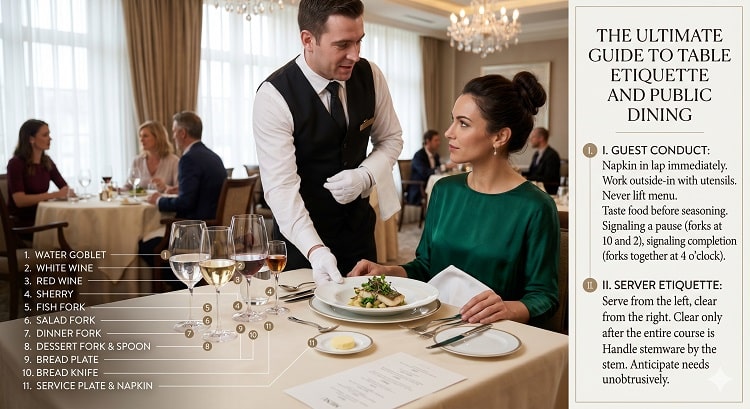 Get all 5. A reservation taken without an arrival time is just a name on a list. According to the National Restaurant Association, no-shows cost the US restaurant industry an estimated $100 per empty seat per evening in lost revenue, a number that compounds quickly in fine dining operations where covers are limited and margins are thin. What happens when reserved guests show up and there’s still a wait? Three steps you should follow, in this order: apologize, give an honest time estimate, tell them where to wait. Don’t just say “it’ll be a few minutes” and disappear. Guests who made a reservation expected the table to be ready – the least they’re owed is a straight answer about how long it won’t be.
Different operations handle reservations differently, and students should know this going in. Some won’t seat a party until everyone has arrived. Others hold the table 15 minutes and then it’s gone. Some call the day of as a reminder. A few charge the credit card on file for no-shows. None of these is wrong – they’re just different policies, and front-of-house staff need to know which ones their operation uses and how to explain them to guests without making it feel like a lecture.
Coats should be checked before guests are seated. A coat draped over a chair crowds the table and gets in the way of service. The maître d’, host, or hostess should ask about seating preference before leading anyone anywhere – not after arriving at a table the guest didn’t want. If that table isn’t available, say so immediately, give a wait time, and lay out the options.
When Guests Are Seated
The napkin question is simpler than people make it: the server can place it in the guest’s lap, or leave it for the guest to handle. Either works. What doesn’t work – tucking it under the chin, stuffing it into a shirt collar, snapping it open with a dramatic shake. Fastening it under a belt to keep it from sliding off is fine, since that’s discreet. Place it on the table so the guest can pick up the nearest edge and unfold it without wrestling with it.
Taking the drink order comes first. If a guest passes on alcohol, that’s the end of it – suggest something nonalcoholic and move on. This isn’t just etiquette but it has legal dimensions. The Dram Shop laws active in 43 US states hold establishments liable for over-service of alcohol. Front-of-house training programs such as the ServSafe Alcohol certification, administered by the National Restaurant Association Educational Foundation, specifically train servers to recognize refusal cues and respond without pressure. Pressing the issue is impolite, and most guests who decline already know what they want instead.
Specials need to be announced slowly and clearly, with a natural pause between each one. Guests are hearing these for the first time. They need a moment to actually think about what’s being described before the next item starts. The pause shouldn’t stretch into something uncomfortable, but it has to be there.
Sharing, Tasting, and Taking Food Home
Guests sometimes want to split a dish or sample what someone else ordered. Sharing between plates is fine; the mechanism matters. If guests want an order split, that happens in the kitchen – not at the table. For tasting, the person with the food transfers a small amount to a plate passed over by the other guest, or passes the whole plate across while the other takes what they’d like and sends it back. Take-home containers are acceptable at most meals. Formal dinners and banquets are the exception.
Getting the Server’s Attention
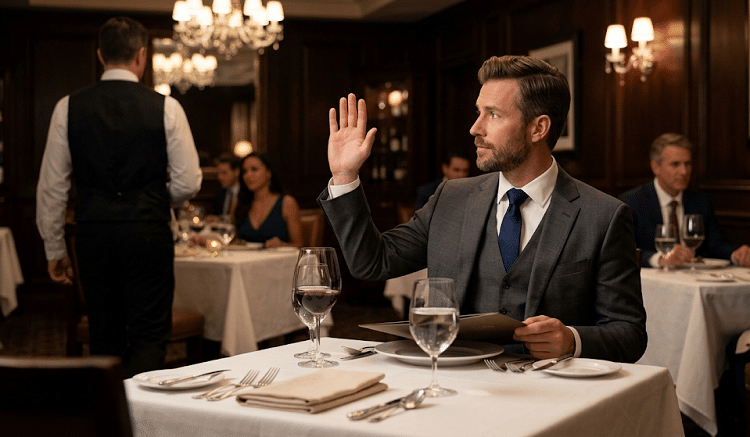 Whistling, clapping, snapping fingers, tapping a glass, stamping feet – all of these are considered rude, and yet guests do them. The correct signal is making eye contact, turning toward the server, and raising a hand. If the server is close, a quiet “server” gets the job done. Students going into service should be prepared for guests who don’t follow this, and should respond without making the guest feel embarrassed about it.
Handling Food Problems at the Table
When a guest is served something they can’t or won’t eat – an allergy, a dislike, whatever the reason – the right move is to leave it and eat everything else without making it an issue. The distinction between preference and allergy matters far more than etiquette alone. Announcing the problem draws attention that most guests would rather avoid. According to a 2023 peer-reviewed study published in Frontiers in Allergy, 1 in 4 serious food allergy reactions occur in dining establishments. An estimated 32 million Americans live with clinically diagnosed food allergies, and the “Big 9” allergens — including peanuts, tree nuts, milk, eggs, and shellfish — account for 90% of reactions annually, per Food Allergy Research & Education (FARE).
For servers, the takeaway is critical: a guest quietly avoiding a dish may be managing a medical condition, not a preference. A 2024 systematic review in Heliyon (University of Granada) found that food service staff who received formal allergen training were significantly more likely to take allergy disclosures seriously and escalate correctly to kitchen staff. In 2016, a UK restaurant chain faced criminal prosecution after a customer with a sesame allergy died following a meal. The case — Natasha’s Law, enacted in the UK in 2021 — directly changed labeling and training requirements across the hospitality sector. US regulations under the FASTER Act (2023) now require sesame to be declared as the 9th major allergen on all food labels.
If something needs to come out of the mouth, it comes out quietly: brought to the front gently, moved onto a fork or spoon, placed on the plate. A fish bone or similar item can be removed with the fingers. Nothing gets spit out. If something inedible turns up in the food, a quiet word to the server handles it. Dropped items get picked up with a utensil, placed on a plate, and removed with it. A real spill – something that soaked the tablecloth – needs the server. Clean it up, cover the spot with a fresh napkin.
Passing and Serving at the Table
Reaching across the table is out and guest should never be reached. You can ask guest to have things passed. When someone is helping themselves from a dish, another guest holding the dish steady makes the whole process easier. For solid items, the Russian technique is the cleanest method: use both the spoon and fork together to lift the item and carry it to the plate.
Handle matters. When passing anything with one – a sauce boat, a bread basket, a pitcher – point it toward the person receiving it.
Butter, jam, jelly, and similar items usually arrive in small covered containers. The routine: remove the cover, use the provided knife or fork to take what’s needed, put it on the butter plate, replace the cover. Servers should clear and replace empty containers right away, not let them sit.
When to Start Eating
Waiting until everyone at the table has been served is proper. At a large table, that could mean some food gets cold – in which case, eat when served. Guests who haven’t received their food yet will often encourage others to go ahead; it’s the considerate thing to do. Servers should aim to bring out the entire party’s orders at once.
Clearing soiled dishes typically waits until the whole table has finished a course. But removing one guest’s plate while another is still eating isn’t wrong – it just needs some reading of the room. When in doubt: “May I take your plate?” is always the right question.
Dishware and Utensils Used
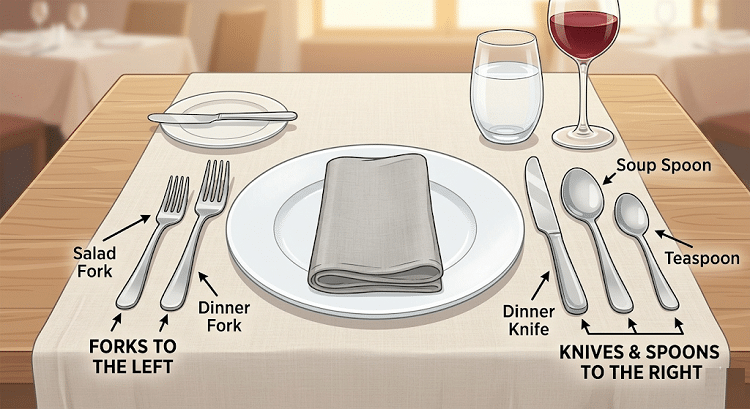 Tableware placement follows a simple rule:
- knives and spoons go to the right,
- Forks to the left.
In the United States, the standard method is to cut with the fork in the left hand and knife in the right, then transfer the fork to the right hand to eat – what’s sometimes called the zig-zag method. Europeans skip that transfer entirely. This distinction matters in professional service. The Emily Post Institute, one of the longest-running US authorities on dining etiquette (established 1946), notes that neither method is incorrect but servers in upscale American establishments should recognize both styles and not interpret the European fork hold as a signal that the guest has finished eating. That misread is one of the most common service errors in formal dining rooms.
After cutting, the fork stays in the left hand and the food comes up to the mouth from there. Both are correct within their own traditions.
Fork grip: hold it at a 40-degree angle, tines pointing down. The thumb goes under the handle, the second finger supports the right side, the index finger presses on the back. It’s fine to push food toward a sauce with the fork before eating it. Keep bites small – that’s true regardless of what’s being eaten.
Animated conversation and flatware don’t mix well. Some guests talk with their hands, which creates real spillage risk. Servers should watch for this and signal before approaching with anything hot. Guests shouldn’t point with utensils or wave them around – especially if there’s food on them.
Navigating a Formal Place Setting
Sit down to 12 pieces of flatware and trust me, most people feel stuck. The rule is outer-to-inner: start with the piece furthest from the plate on either the right or left, and work inward as the courses progress. By the time dessert arrives, only the dessert fork and spoon should be left – sometimes placed at the top of the cover rather than to either side.
Occasionally the first utensil arrives with the food itself. A shrimp cocktail, for example, might come with the cocktail fork already on the plate – that’s the one to use, regardless of what’s still sitting on the outer right. Glassware follows the same outer-to-inner logic.
Some place settings create genuine confusion. The teaspoon might sit on the outer right while the soup spoon sits just inside it – which means the soup spoon is actually first, since soup is the first course. The outer position isn’t always the first-use position. Servers should be ready to help guests sort this out without making it awkward.
When someone’s done eating, the knife and fork go side by side on one side of the plate, both pointing the same direction. The traditional signal is to leave them crossed in the center. Either way, used flatware doesn’t go back on the table, and guests shouldn’t be expected to reuse it. Fresh pieces come with every new course.
Glasses: fingers off the rim. Stemmed glassware gets held by the stem.
Etiquette for Specific Foods
Servers who know how particular foods are properly eaten can do a lot to help guests – especially guests trying something for the first time. Just getting the service right often tells the story. A guest who doesn’t know how to eat something can ask, or watch what others do and follow along. Neither is wrong.
Finger Foods: Standing and eating at the same time is genuinely awkward – the textbook isn’t wrong to call it acrobatic. Party planners should make seating available wherever possible. Where it isn’t, small stands let guests set their drinks down while eating. Bus stands need to be close by; guests won’t walk across a room to dispose of a plate, and if there’s nowhere obvious to put things, they end up on bookshelves and armchairs. Event planners and catering managers cite this as one of the most consistent failures at cocktail receptions. The National Association for Catering and Events (NACE) recommends one bus station per every 25–30 guests at standing receptions as the operational baseline – a standard that most private hosts and even some hotels routinely underestimate.
Napkins matter more with greasy or moist finger foods – stock plenty of them. Finger bowls or small hot cloths are an option for messier items. Anything coming fresh from the kitchen needs a warning; small picks make hot finger foods easier to handle and keep fingers cleaner.
The five-inch bread-and-butter plate is the standard at cocktail events. Guests pick up food from a buffet or receive it from servers passing through the room. Once something’s been dipped – into a sauce, a dip, anything – it doesn’t go back in. One dip.
Picnic foods like hot dogs, hamburgers, and tacos are easier to manage wrapped in a napkin. Ribs are finger food, full stop – and saucy ribs need extra napkins or a moist towel. A finger bowl at the end is appropriate where the operation uses them.
For skewered items: lift by the handle, push the pieces onto the plate with a fork, set the skewer aside on a plate.
Soups: Soup comes in a bowl or a two-handled cup. The cup can be lifted to drink from when only a little remains – but only for thin soups. Drinking from a bowl is considered uncouth. So is blowing on soup to cool it down. Instead, fill the spoon partway and let it sit for a moment before eating.
The soup spoon moves away from the body across the bowl – not toward it. To get the last of it, tip the bowl away from yourself slightly and spoon from the far side. When done, the spoon stays in the bowl, not on the table.
Croutons get served with a spoon, never by hand. Crackers are better eaten on the side, though crumbling them into the soup isn’t a real violation.
Breads: Rolls, sliced bread, whole loaves – bread shows up in a lot of forms. A whole loaf should arrive on a cutting board with a serrated knife; a napkin lets guests hold the loaf steady while cutting.
Vegetables: Most vegetables aren’t complicated. Corn on the cob can be held with one hand, both hands, or cob holders pushed into the ends – season it first. Artichokes take a bit more patience: pull leaves off one at a time, dip the tender end in sauce, scrape the soft flesh with the teeth, place the leaf on a provided plate. The heart is under a layer of thistles – scrape those off, then eat the heart with a knife and fork. Asparagus can technically be picked up with the fingers, but a fork and knife is the more proper approach.
Sauces come either plated with the dish or in a sauce boat at the table. Servers should ask whether guests want sauce and how much, or leave the boat so guests can add more themselves.
Salads: A knife is fine for cutting large leaves, vegetables, or meat in a salad. If a guest wants the salad alongside the main course rather than before it, move it to the left. Dressing on the side means a small container placed next to the salad – not poured on by the server without asking.
Pasta: Long pasta has two common approaches. The first: twirl a small amount of strands around the fork while supporting it with a large spoon. The second: hold the fork nearly vertical against the plate and rotate it until the right amount wraps around. Some guests just gather and lift without twisting – harder to manage, since rolling the pasta down to a smaller, more compact bite is genuinely easier to get into the mouth cleanly. All three methods are acceptable.
Conclusion: The thing is, at the end of the day, good etiquette isn’t about memorizing every single detail, but it’s really just about making sure that everyone at the table feels comfortable. Once you have these basic mechanics down, you can stop stressing over the silverware and start just enjoying your meal.
